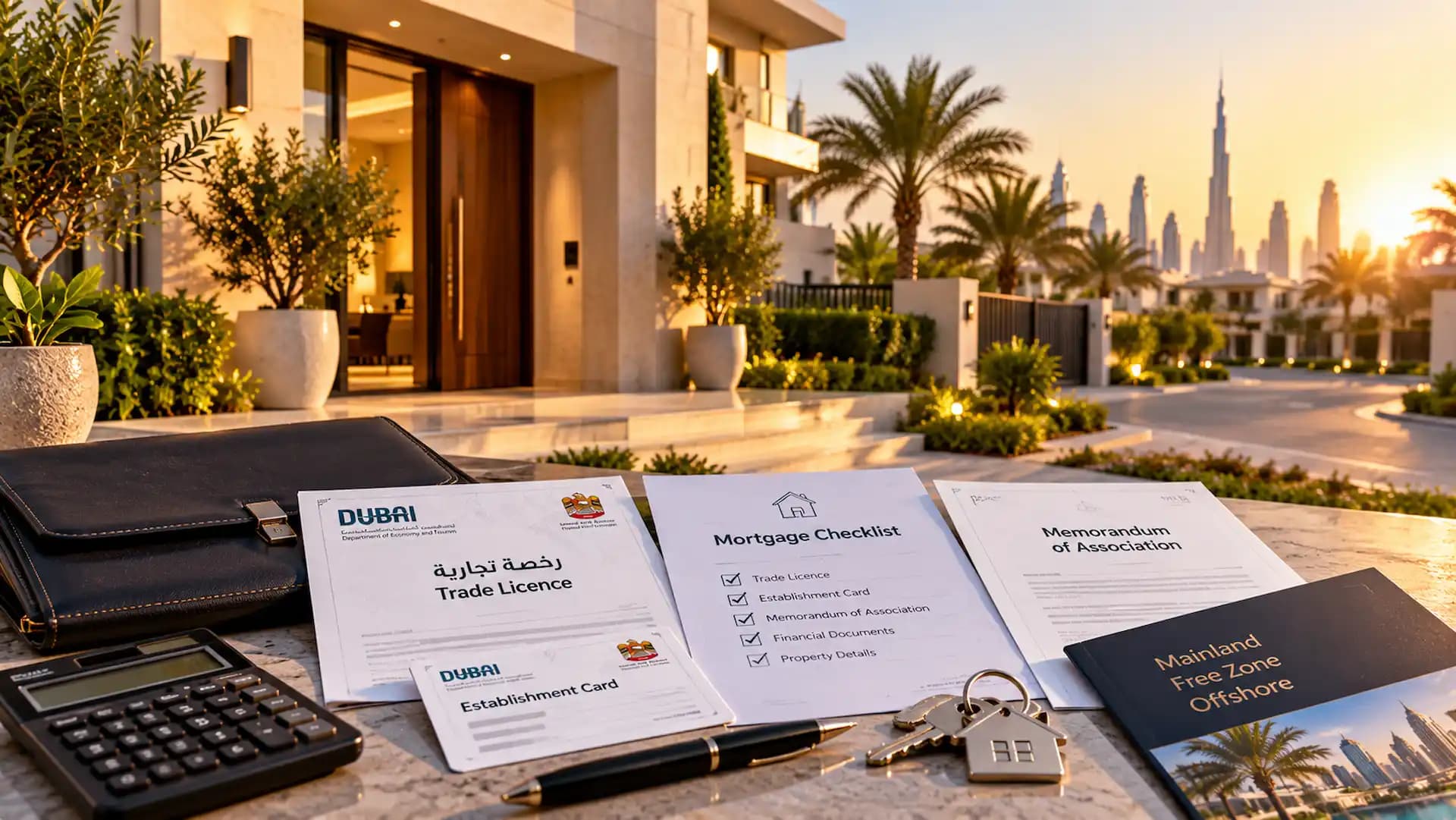
For a business owner, the trade licence is the first page of a mortgage application. Before an underwriter opens your accounts or bank statements, they look at the licence and ask four questions. Where was it issued? How old is it? What activity does it allow? Who does it say owns the business?
Get those answers right and the rest of the file is about numbers. Get one wrong, and a profitable business can be declined at the first step, or sent to a lender with worse terms.
This guide looks only at the licence: the types banks see, how they count its age, the activities that change a lender’s appetite, the cards and premises that sit behind it, and the small details that cause problems. How banks then turn your business into an income figure is covered in self-employed mortgages in Dubai.
Mainland and free zone licences are both mainstream. There is no general rule that one is better than the other for a home loan. What matters more is that the company is active, has real premises or a recognised desk, banks in the UAE and has been trading long enough.
Offshore licences are a different matter. An offshore company cannot trade in the UAE, does not sponsor visas and usually has no local operations for a bank to verify. Lenders are very reluctant to treat it as the source of a borrower’s income. If you hold assets or contracts through an offshore company, expect the bank to look for your income elsewhere, for example in an operating company or your drawings.
Not all free zones carry the same weight. There are more than 40 free zones across the emirates. Large, long-established zones with strong compliance records are familiar to every underwriter. A licence from a smaller or newer zone, particularly with a flexi-desk and few visas, may get more questions. That is not a decline, but it is a reason to choose the lender carefully.
Take a consultant who traded through a free zone company from March 2023, then set up a mainland LLC in January 2025 to win government clients, and closed the free zone company. Applying in October 2026, the mainland licence is 21 months old, while the business itself has traded for three and a half years with the same owner, activity and clients.
A bank that counts only the current licence will say it is too young. A bank that looks at continuity of the business will accept it, provided the consultant can show the old licence, accounts or statements from the free zone company, and the same clients moving across. That is why, if you have restructured, you should keep every document from the earlier entity and tell the lender the full story from the first conversation.
If your business is genuinely under two years old, the options narrow, and most of them depend on long prior experience in the same field. That deserves its own discussion, but the short version is: avoid restructuring in the two years before you plan to buy.
Mainland, free zone or offshore
The UAE has three broad kinds of business licence, and banks treat them differently.| Mainland | Free zone | Offshore | |
| Issued by | The emirate’s economic department, such as Dubai’s Department of Economy and Tourism | The free zone authority, such as DMCC, IFZA, DDA or JAFZA | An offshore registry, such as JAFZA Offshore or RAK ICC |
| Where it can trade | Anywhere in the UAE and abroad | Within the zone and abroad; selling goods on the mainland needs extra steps | Outside the UAE only; no local trading |
| Premises | A physical office with a registered lease | Often a flexi-desk or shared office | A registered agent’s address |
| Can sponsor visas | Yes | Yes, within the zone’s quota | No |
| How banks see it for a mortgage | Widely accepted | Widely accepted from established zones | Rarely accepted as the income source on its own |
Licence type and legal form
Inside each category, the licence also states what kind of business you have. Two details on it matter to a lender. The licence category. Dubai mainland licences are broadly commercial (trading), professional (services and skills) or industrial (manufacturing). Professional licences for consultants, designers or engineers tend to be read as lower risk than general trading, because income depends on skills and contracts rather than stock and credit. The legal form. A sole establishment, a civil company of professionals, a limited liability company, a branch, or a free zone entity such as an FZE, FZCO or FZ-LLC. The legal form tells the bank how ownership and liability work. For a sole establishment, the business and the owner are effectively the same person. For an LLC, the bank will want the memorandum of association to see who owns what.How licence age is counted
Most lenders want the licence to be around two years old, and some ask for three. The question that causes the most confusion is: two years from when? The general answer is from the date the licence was first issued, not from the latest renewal. A licence first issued in 2021 and renewed last month is five years old. The renewal date only tells the bank the licence is current. The difficulty comes when the business changes shape. Each of these can create a new licence, a new licence number or a new company, and some banks will start counting again from that point:| Change to the business | Effect on the licence | How lenders tend to react |
| Renewal | Same licence, new expiry date | No effect |
| Adding an activity | Same licence, amended | Usually no effect, though income from the new activity may need its own history |
| Changing the trade name | Same licence, amended | Usually no effect, with evidence of the change |
| Adding or removing a partner | Amended MOA and licence | Your share is assessed from when it changed |
| Moving from a free zone to the mainland, or between zones | Usually a new company and new licence | Some banks restart the clock; others accept continuity |
| Changing legal form, for example sole establishment to LLC | Often a new licence | As above |
| Buying an existing business | Old licence, new owner | Assessed from when you became the owner |
Activity type: why some businesses need a different bank
Every lender keeps an internal view of which sectors it is comfortable with. The licence tells the bank your sector, so your activity can decide the lender before your income does. Activities that commonly get more caution, or are excluded at some banks, include:- General trading, especially with high cash turnover or cross-border flows
- Gold, jewellery and precious metals
- Virtual assets and crypto-related activities
- Money exchange and payment services
- Used car trading
- Some contracting and construction activities, where income can be lumpy and receivables slow
The establishment card, premises and visa
Behind the licence sit a few other documents that a bank may ask for, and that show the business is real. The establishment card. This registers your company with the immigration authority, the GDRFA in Dubai or the ICP in other emirates, so it can sponsor residence visas. Mainland companies usually also have a labour file with the Ministry of Human Resources and Emiratisation to issue work permits and run payroll through the Wage Protection System. The establishment card is not a licence or a visa, and it renews on its own cycle, usually yearly. Banks may ask for it to confirm that the company sponsors you, and an expired card suggests the company’s paperwork is not in order. Premises. A mainland company needs a registered office lease, and in Dubai that is registered through Ejari. A free zone company may have an office, a warehouse or a flexi-desk. Lenders do not decline flexi-desk companies as a rule, but a real office, staff and visas all make the business look established. Your own visa. If your company sponsors your residence visa, your visa depends on the licence and the establishment card staying valid. A lapse in one can affect all three, and a bank will not complete a mortgage for a borrower whose visa is about to expire.Details that cause problems
Most licence issues are small and easy to fix, but only if you find them before the bank does.- The licence expires mid-application. Mortgages can take several weeks. If your licence or establishment card expires within the next two to three months, renew it first.
- Ownership on the MOA does not match what you say. The bank goes by the documents. If your company still has an older arrangement where a local partner holds 51% on paper, most banks will count only the share the MOA shows as yours, whatever side agreements say. Since 2021, many mainland activities can be 100% foreign-owned, and restructuring to reflect real ownership can help, though it may itself count as a change. Plan it well ahead of any purchase.
- The trade name or activity changed recently. Bring the amendment history.
- The licence is in another emirate. That is fine, but the bank may need to verify it through that emirate’s authority, which can take longer.
- The company does not bank in the UAE. A business that receives most of its income into an account abroad is hard to verify. Keep the main operating account here, and if your company has struggled to open or keep one, resolve that well before you apply.
- Free zone tax status. If your free zone company is a Qualifying Free Zone Person paying 0% corporate tax on qualifying income, it must prepare audited accounts, which is useful to a lender. If it has lost that status, it pays 9% on profits above AED 375,000, so make sure the accounts reflect it.
Choosing the right licence if you are setting up now
If you are forming a company and expect to buy property within a few years, a little planning helps:- Choose a licence category and activity that describe your business accurately, and avoid a broad general trading licence if you do not need one.
- Pick an established free zone or the mainland, depending on where your clients are, rather than the cheapest package.
- Open a UAE business account early, and run all income through it.
- Get the establishment card and your own visa under the company, if it will be your sponsor.
- Avoid restructuring in the two years before you buy.